
Paul Tully – July 2026
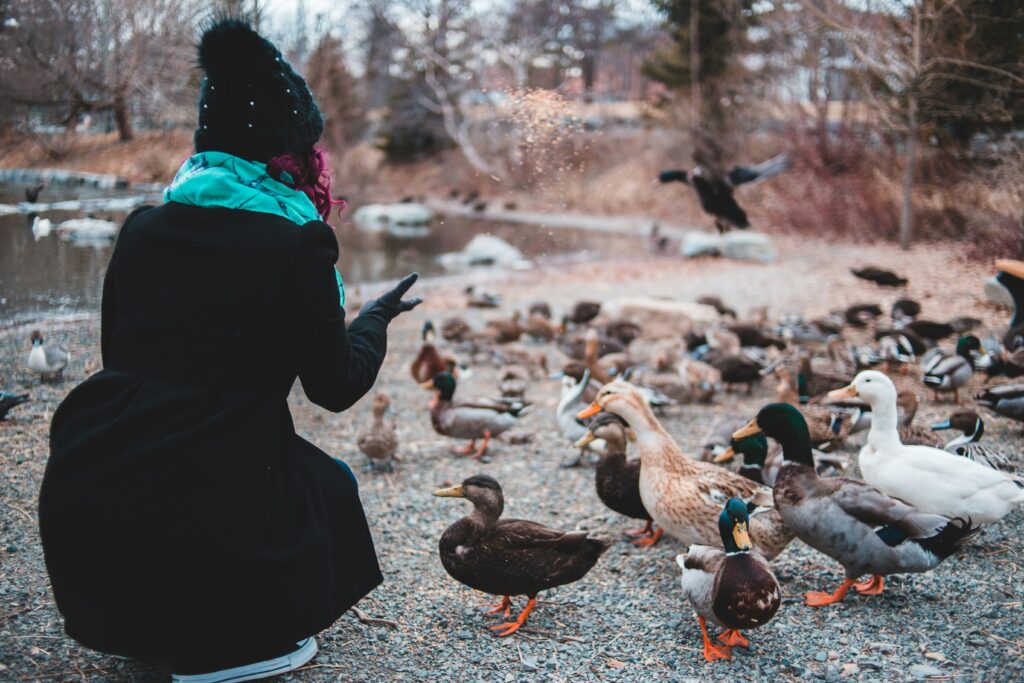
In my PhD, I studied the pond in the Botanic Garden of Dunedin, New Zealand, as a place that entangles the interests of multiple species. This work contributed to the ‘animal turn’ happening in leisure studies and the wider social sciences (Danby et al., 2019), which recognises that nonhuman animals in leisure environments possess sentience and agency. This mirrors people who also possess sentience and act with agency in the same places. For many decades, research and societal thinking have centred humans as the only (or most important) beings with inherent interests due to sentience, thus ignoring nonhumans as nothing more than passive members of the social world. This has been built into the world as binary thinking between humans and nonhumans and has recently been challenged by developments in posthumanism (Cohen, 2019). Therefore, the ‘animal turn’ is driven by an increasing awareness of the multispecies nature of the world’s activities and especially the entanglements of animals.
Yet, as my PhD progressed, I became aware of a calling for a more-than-animal approach. My research training and more general education had taught me the importance of a human-centric focus, humans and human activities were to be centred as most significant, but I was challenging this by incorporating more-than-human animals. Yet, in doing so, I recognised that such a challenge was weak for what was needed for research that was inclusive and just for all. In this post, I present an excerpt from my doctoral conclusion that discusses my realisation. This has implications for how people view the leisure-scape in which they and all actively participate.
Entangled aliveness
Coming into my PhD, I positioned sentience as a critical part of my inquiry. This was because sentience is a central feature of animals and, thus, is tied to the inherent interests that individuals possess in experiencing life (Broom, 2014; Carr & Broom, 2018). It was the concept of sentience, referring to the natural internal capacities and capabilities of living individuals, that spoke to me of a better principle than posthuman philosophical ideas, which aim to flatten ontology and reduce all entities to equal (Nimmo, 2011). In other words, it gave me a way to make animal organisms more valued than inanimate objects. I knew that if an organism is considered sentient, then moral treatment of that individual should become a concern (Lockwood, 1988). Hence, my use of sentience was a continuation of animal ethics debates that have been around for decades (Singer, 2015). As my doctoral research has progressed, however, I have come to think that the importance placed on sentience was an error. I have arrived at such a view due to “the problem of sentience” (Candiotto, 2025, p. 192), which is that determinants of sentience lie with humans.
This problem of sentience creates various issues. For instance, people attribute sentience via different definitions, ranging from having basic feelings (i.e., pain) to having feelings due to awareness and cognitive abilities (Broom, 2014; Thompson, 2022). Some wonder whether an agency without feelings should be seen as a form of sentience (Lawrence 2022; Marder 2012). Likewise, debates arise over whether organisms with conscious experiences but no apparent ability to differentiate between feelings (i.e., pleasant/unpleasant) should be considered sentient (DeGrazia, 2020). Hence, the definition of sentience is not steadfast and alters depending on the person and their interests in the concept. Within this context, people move the goalposts in decisions concerning who is sentient and deserving of moral concern in their humancentric world. In addition, we humans expect nonhumans to live up to our ideas or risk getting dismissed as unemotional, unfeeling, unaware and generally unworthy of care. We expect them to demonstrate their sentience in human-designed and controlled ways. For instance, in an experiment where a scientist electrocutes a rat’s tail and infers from its responses a feeling of pain or not, for their classification to be verified (Mayer et al., 1971; Shute, 2024). In short, humans act as arbiters over nonhumans in a world that people think belongs to them. This all seems grossly unfair and something that is imbued with humancentrism. As such, I have come to see sentience as just another tool in the human power over game that disregards the nonhuman Other. It is an apparatus for the implementation of categorisation used to separate us from them. Hence, sentience encapsulates reasons for the removal of dualist thinking.
Since completing my work, I have thought that rather than an acceptable show of sentience, humans should focus on an aliveness. Clearly, in recognising the sentience of an individual, people are accepting their alive nature. It is a judgement that an individual experiences across the physical, mental, emotional, and social spheres of life, with affect felt from the stimuli they encounter (Tully & Carr, 2022). There should also be recognition of their awareness and agentic ability to generate stimuli that create affect in the world around them (Wilcox, 2020). In judging sentience, people’s focus is on proving the experiential aspects of being alive, the feelings, awareness, emotions, and agency of an individual (Broom, 2014). Hence, we run experiments to try to infer about the inherent subjective experiences of an individual, something that is unknowable to us. Yet, what if the crucial point is the capacity to affect and be affected? As Singh (2017) remarks, “to affect and be affected is to be open to the world and to the possibility of being transformed through this engagement” (p. 759). This is aliveness. Moreover, we humans know, if truthful to ourselves, that being alive does not mean remaining the same, but being on a journey of constant transformation from a point of beginning to end. Within this context, we need no longer concern ourselves with whether an organism experiences the supposed correct things in experiments to be classified as sentient, and instead witness transformations that happen around us in everyday life.
The more time I spent observing the pond in this study, the more I came to appreciate its aliveness. This includes more than the animal dynamics covered in this thesis, and acknowledges the transformations taking place across all forms. I came to see how these animal entanglements were a small part of an ever-evolving environment of entangled aliveness. The plant life was ever-changing, under duck trampling, human cultivation, and an inherent ability to grow, flourish, and die in line with the yearly seasons. The insects were enlivened by the duck faeces and destroyed due to human sensitivities, but were always varying in the space, dependent on climatic conditions. The bacteria transformed atmospheric senses until humans washed them away, which in the process transformed the atmosphere of the space once more. The wear from rain, seed scattering, duck pooping, and human power washing has continually transformed the wooden pontoon into an ever-more worn and beat-up looking structure during my three years visiting. Likewise, the wooden benches that enabled me to sit and watch, once a tree that humans have adapted, have been transformed by the climate, people, and the pigeon poop of the space. In short, I came to appreciate through this work the true relational nature of the world, and something that does not require complex posthuman theorising about agency in networks or assemblages, but simple everyday observations of aliveness. Thus, a witnessing of transformations from the moments past. When witnessing transformations in everyday life, the need to appreciate the aliveness of everything calls. This brings a fair view of an inherently entangled multispecies world in which, importantly, the biological sphere and sociocultural realm affect and are affected by each other.
Seeing transformations can bring a view of the world that includes sociocultural aspects that, to me, often feel incorrectly minimised by posthumanism. As Weber (2015) explains, a focus on aliveness as the “critical, connecting element” (p. 372) in an entangled multispecies world does not limit a view of separated nature and culture. As such, we get to the posthuman wish of recognising naturecultures (Haraway, 2008). This is because visible is an aliveness that is “intrinsic to all social and biological systems” (Weber, 2015, p. 372). Moreover, everything is on a transformative journey from a point of beginning to end, in which it affects and is affected by the happenings in the world. The biological sphere may be transforming through engagement in the world, but the social realm and culture are not static around it. The actions of the settler culture of early twentieth-century New Zealand have not remained stationary up to the current twenty-first century, even if their influence is still present. As seen through the colonisers in New Zealand, humans attempted to instigate a culture of domination in the multispecies community, and whilst the consequential elements of this remain, the journey is an ongoing transformation, which is the slow subsuming of colonisation into a transformed society. Hence, to reimagine the human in this entangled multispecies world is to recognise that how we transform our sociocultural aspects is just as vital as how our acts transform the biological sphere.
From prioritising individuals to the whole system
As I reflect on my PhD, I recognise that my worldview has been on a constant journey since entering the academic realm. I’ve learnt the methods of humancentrism, learnt about and participated in challenges to such practices, and questioned if I’m anywhere near finding a comfortable way of looking at the world. Does a view that can be inclusive and just across the socio-environmental dynamics exist? I believe in my apprehension of the entangled aliveness set out in the above passage; my answer is closer. Perhaps, what I am looking for is to be found not in one Westernised worldview but in an amalgamation of diverse worldviews. Thus, appreciating all ways of looking not hierarchically but as complementary to one another. I question whether my answer is in a socio-ecological systems perspective that appreciates the planetary dependence on networked relations (Pullanikkatil & Hughes, 2022). This is likely to be my next journey of discovery. What is certain, though, is a move from an individual, human-centred focus to an appreciation of the complex relational whole.
The above work contains excerpts from chapter 12 of the thesis Duck tales & Beyond, submitted by Paul Tully at the University of Otago for the degree of Doctor of Philosophy.
Bibliography
Broom, D. M. (2014). Sentience and animal welfare. CABI.
Candiotto, L. (2025). The problem of sentience. Phenomenology and the Cognitive Sciences, 24(1), 191–211. https://doi.org/10.1007/s11097-024-09994-7
Carr, N., & Broom, D. M. (2018). Tourism and animal welfare. CABI. https://doi.org/10.1079/9781786391858.0135
Cohen, E. (2019). Posthumanism and tourism. Tourism Review, 74(3), 416-427. https://doi.org/10.1108/TR-06-2018-0089
Danby, P., Dashper, K., & Finkel, R. (2019). Multispecies leisure: Human-animal interactions in leisure landscapes. Leisure Studies, 38(3), 291-302. https://doi.org/10.1080/02614367.2019.1628802
DeGrazia, D. (2020). Sentience and consciousness as bases for attributing interests and moral status: Considering the evidence and speculating slightly beyond. In L. S. M. Johnson, A. Fenton, & A. Shriver (Eds.), Neuroethics and nonhuman animals (pp. 17–31). Springer. https://doi.org/10.1007/978-3-030-31011-0_2
Haraway, D. J. (2008). When species meet. University of Minnesota Press.
Lawrence, A. M. (2022). Listening to plants: Conversations between critical plant studies and vegetal geography. Progress in Human Geography, 46(2), 629-651. https://doi.org/10.1177/03091325211062167
Lockwood, J. A. (1988). Not to harm a fly: Our ethical obligations to insects. Between the Species: An Online Journal for the Study of Philosophy and Animals, 4(3), 204-211. https://doi.org/10.15368/bts.1988v4n3.10
Marder, M. (2012). Plant intentionality and the phenomenological framework of plant intelligence. Plant Signaling & Behavior, 7(11), 1365-1372. https://doi.org/10.4161/psb.21954
Mayer, D. J., Wolfle, T. L., Akil, H., Carder, B., & Liebeskind, J. C. (1971). Analgesia from electrical stimulation in the brainstem of the rat. Science, 174(4016), 1351–1354. https://doi.org/10.1126/science.174.4016.1351
Nimmo, R. (2011). Actor-network theory and methodology: Social research in a more-than-human world. Methodological Innovations Online, 6(3), 108-119. https://doi.org/10.4256/mio.2011.010
Pullanikkatil, D., & Hughes, K. (Eds.). (2022). Socio-ecological systems and decoloniality: Convergence of indigenous and western Knowledge. Springer International Publishing. https://doi.org/10.1007/978-3-031-15097-5
Shute, J. (2024). Stowaway: The disreputable exploits of the rat. Bloomsbury.
Singer, P. (2015). Animal liberation. The Bodley Head.
Singh, N. (2017). Becoming a commoner: The commons as sites for affective socio-nature encounters and co-becomings. Ephemera: Theory and Politics in Organization, 17(4), 751–776.
Thompson, E. (2022). Could all life be sentient? Journal of Consciousness Studies, 29(3), 229–265. https://doi.org/10.53765/20512201.29.3.229
Tully, P., & Carr, N. (2022). Animal sentience. In D Buhalis (Ed.), Encyclopedia of tourism management and marketing. Edward Elgar Publishing. https://doi.org/10.4337/9781800377486.animal.sentience
Weber, A. (2015). Reality as commons a poetics of participation for the anthropocene. In D. Bollier & S. Helfrich (Eds.), Patterns of commoning (pp. 369–391). The Commons Strategy Group/Off the Commons Books.
Wilcox, M. G. (2020). Animals and the agency account of moral status. Philosophical Studies, 177(7), 1879–1899. https://doi.org/10.1007/s11098-019-01289-x